close

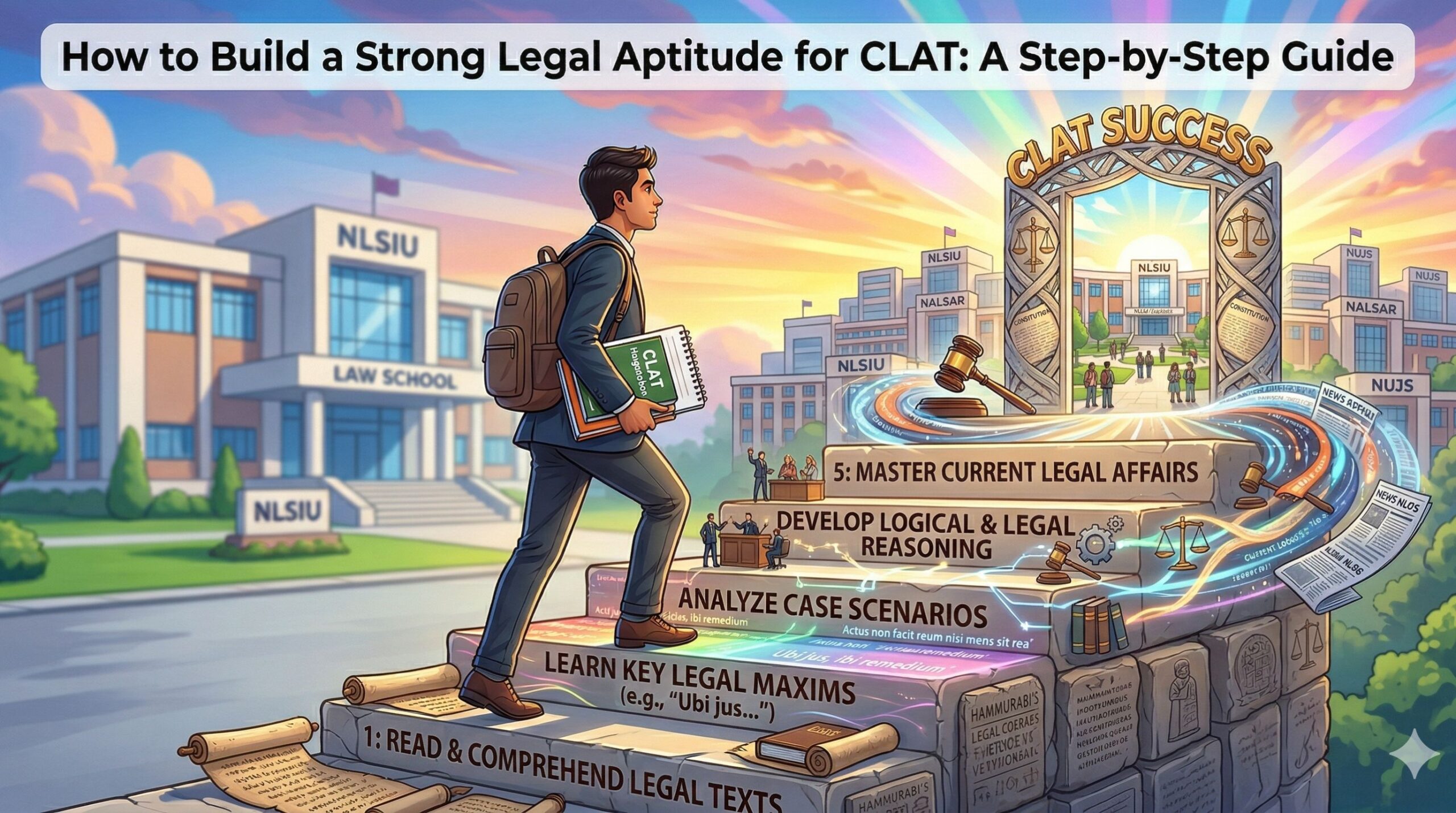
How to Build a Strong Legal Aptitude for CLAT: A Step-by-Step Guide

For any aspirant eyeing the National Law Universities, the Legal Reasoning section is the “heart and soul” of the CLAT Exam. Accounting for roughly 25% of the total marks, this section doesn’t just test your knowledge of laws; it tests your ability to think like a lawyer.

However, many students feel overwhelmed by legal jargon and complex statutes. In this guide, we break down how to master the CLAT entrance test by building a formidable legal aptitude from scratch, using proven CLAT Strategies for Students.

1. Understanding Legal Aptitude in the “New” CLAT

The CLAT law exam has undergone a massive shift. Gone are the days of simple Principle-Fact questions. Today, the exam presents you with 450-word passages based on contemporary legal issues, followed by a series of questions that require you to apply the logic of the passage to new factual scenarios.

To succeed in this law entrance exam, you must move beyond memorization and focus on Legal Logic.

2. The 4-Step Roadmap to Legal Mastery

Step 1: Master the Core Pillars of Law

While the CLAT Exam technically doesn’t require a law degree, having a foundation in core legal subjects helps you read passages faster. Focus your CLAT Preparation on:

  • Law of Torts: Understand negligence, vicarious liability, and strict liability.
  • Contract Law: Master offer, acceptance, consideration, and breach.
  • Criminal Law: Learn the difference between Mens Rea (guilty mind) and Actus Reus (guilty act).
  • Constitutional Law: Focus on Fundamental Rights, Directive Principles, and the powers of the Judiciary.

Step 2: Develop a “Neutral” Perspective

One of the most common mistakes in the CLAT law exam is letting your personal “moral compass” interfere with the legal principle.

  • Strategy: Even if a principle seems unfair, you must apply it strictly to the facts provided. In the courtroom of CLAT, the passage is the only law.

Step 3: Speed Reading and Comprehension

Since the CLAT entrance test is entirely passage-based, your legal aptitude is limited by your comprehension speed.

  • Action Plan: Read legal editorials from The Hindu or LiveLaw. Practice identifying the “ratio decidendi” (the reason for the decision) in summarized court judgments.
  • These will help you understand and get familiar with the language used in legal passages and build your comprehension speed.
  • DO NOT just read fast, try to comprehend the passage also. Else you will make mistakes in the tests.

Step 4: The Art of Eliminating Options

In the CLAT Exam, two options often look correct. Building aptitude means learning to spot the “distractor” options—those that are too broad, too narrow, or introduce facts not mentioned in the passage.

3. Advanced CLAT Strategies for Students

At CLAT Possible, we emphasize that legal aptitude is a muscle—it grows with resistance.

  1. Contextual Learning: When you hear about a new bill in the news (like the Bharatiya Nyaya Sanhita), don’t just read the headline. Look for the legal arguments for and against it.
  2. Mapping the Logic: When practicing, physically underline the “Rule” in the passage and the “Fact” in the question. Mentally draw a line connecting them.
  3. Time-Bound Practice: Never solve legal reasoning questions without a timer. Aim for 1 minute per question to mirror the pressure of the actual law entrance exam.

4. Frequently Asked Questions (FAQs)

1. What is legal aptitude in CLAT?

Legal aptitude is the ability to understand legal propositions (rules) and apply them to a set of facts to reach a logical conclusion. It evaluates your reasoning skills, attention to detail, and your ability to remain objective.

2. Do I need prior legal knowledge for CLAT legal reasoning?

Technically, no. The CLAT Exam provides all the necessary information within the passage. However, having a basic understanding of legal terminology and concepts (like ‘voidable contracts’ or ‘actionable claim’) significantly increases your reading speed and accuracy.

3. How can I improve my legal reasoning skills for CLAT?

The best way to improve is through “Active Analysis.” Don’t just check if your answer is right; read the explanation to understand why the other three options were wrong. Supplement this with CLAT Preparation modules that focus specifically on passage-based reasoning. Practice a lot and familiarize yourself with legal passages. 

4. Are previous year CLAT questions helpful for legal aptitude?

Absolutely. Previous year papers are the most authentic resource for any law entrance exam. They help you understand the “depth” of the questions asked and the specific logic used by the Consortium of NLUs.

Conclusion: Turning Aptitude into a Rank

Building a strong legal aptitude for the CLAT Exam is a marathon, not a sprint. It requires a shift in how you process information—from a passive reader to an active legal analyst. By following this step-by-step guide and staying consistent with your CLAT Preparation, the doors to your dream NLU will swing wide open.

Struggling with complex legal passages? [Join a Free Legal Reasoning Masterclass at CLAT Possible] and learn the ‘Zero-Error’ strategy from India’s top legal mentors!

Also Read:

Top CLAT Preparation Books Every Aspirant Should Have (2026-27 Edition)

Securing a seat in a top-tier National Law University (NLU) is as much about the quality of your study material and resources as it is about your hard work. With the CLAT Exam evolving into a high-speed, comprehension-heavy marathon, relying on outdated materials can be a costly mistake.

To help you navigate the sea of study materials posing as clat expert material, we have curated the ultimate list of CLAT preparation books and resources. Whether you are looking for clat preparation online or seeking the clat best coaching in india, having these core texts on your desk is the first step toward success.

Why Choosing the Right Books Matters for CLAT 2026

The current pattern of Clat Exams requires you to read and process nearly 30 pages of text in 120 minutes. Your books shouldn’t just teach you the law; they should teach you how to read, analyze, and eliminate options under pressure.

Below is the section-wise list of must-have books for your 2026-27 journey.

1. English Language: Building Stamina & Vocabulary

Since every section in CLAT is now passage-based, your English skills are the foundation for the entire paper.

  • Cp’s Black Book of Vocabulary The gold standard for vocabulary. It uses a root-word approach that helps you decode difficult words in passages. Also it has a list of frequently asked words in the wordlist. The chapter on word clusters gives you words with their synonyms and antonyms. These help you get a command over learning new words in context.
  • Roznama (App) Daily Vocabulary: with Roznama you get 20 high frequency words that are most likely to come in exams along with with usage and quiz. Learn on the spot and test.
  • High School English Grammar and Composition by Wren & Martin: Essential for clearing up those tricky grammar concepts that appear in “error spotting” or “sentence correction” questions.
  • Editorials from The Hindu & Indian Express: Not a book, but arguably more important. Reading these daily is a core CLAT preparation habit to improve reading speed. In Roznama CP gives the day’s 5 editorial articles for practice and reading in case you missed the newspaper that day.

2. Legal Reasoning: The Heart of the Paper

This section tests your “legal mind.” You don’t need to be an expert in the Indian Penal Code, but you must understand how to apply rules.

  • CP’s Black Book of Legal Reasoning by Aakash Prasad: This is widely considered the best for understanding legal principles. It explain all the concepts of Constitution, Tort, COntracts in a student friendly manner that you not only understand but remember.
  • The EBC Guide to the CLAT by Clat Possible: Excellent for practice questions and conceptual clarity on Torts, Contracts, and Constitutional Law.
  • CLAT Possible’s Specialized Modules: Our internal modules are updated annually to include recent landmark judgments like the shift to the Bharatiya Nyaya Sanhita (BNS).

3. Logical Reasoning: Critical Thinking Mastery

CLAT has moved away from “puzzles” and toward “critical reasoning” (Assumptions, Conclusions, Strengthening/Weakening arguments).

  • CP’s Black Book of Critical reasoning: the ONLY book written for CLAT and AILET examination in the country. It has been authored by Clat Possible’s top CR mentors adapted to CLAT style passage based reasoning. The book explains the concepts of assumption, inference and main point along with syllogisms and then gives questions per chapter on both passages and small arguments for optimum practice.  Great for a wide variety of practice sets.
  1. Current Affairs & General Knowledge
  • Manorama Yearbook: Perfect for static GK and a year-end review of major events.
  • CLAT Possible’s Monthly GK Compendiums: In the world of clat preparation online, our monthly capsules are curated to filter out the noise and focus only on what’s relevant for the exam.

5. Quantitative Techniques: The DI Specialist

  • Quantitative Aptitude for Competitive Examinations by R.S. Aggarwal: Use this to build your base in percentages, ratios, and averages.
  • Fast Track Objective Arithmetic by Rajesh Verma: Useful for learning shortcuts that save precious seconds during the exam.

CLAT Strategies for Students: How to Use These Books

Having the books is one thing; using them effectively is another.

  1. Avoid Book Hoarding: Stick to one primary book per subject. Mastery over one source is better than being confused by five.
  2. Integrate Online Learning: Combine these texts with clat preparation online via webinars or recorded sessions to see how experts solve the same problems.
  3. Active Reading: When reading your English or Legal books, always keep a timer. Aim to finish a passage and its 5 questions in 6–8 minutes.

Frequently Asked Questions (FAQs)

1. Which books are best for CLAT preparation?

For a complete beginner, the “Big Three” are CP’s black Book of Critical Reasoning (Logic), CP’s Black Books (Legal), and Roznama  (daily mini CLAT for Current Affairs and all subjects). Combined with a reliable mock test series from the clat best coaching in india, these provide a rock-solid foundation.

2. Which book is best for CLAT legal aptitude?

CP’s Black Books for Legal Aptitude by Aakash Prasad is the most recommended. It effectively bridges the gap between static legal knowledge and the application-based reasoning required in the modern CLAT format.

3. Are NCERT books useful for CLAT?

NCERTs are useful for the Quantitative Techniques section (specifically Class 8-10 Math) to clear your basics. They are also helpful for Static GK (History and Geography), but they are not sufficient on their own for the comprehension-heavy English or Legal sections.

4. Should I focus more on books or mock tests for CLAT?

While books build your foundation, mock tests win you the rank. In the first 6 months, focus 70% on books and 30% on mocks. In the final 3 months, flip that ratio. Analysis of mocks is where the real learning happens.

Conclusion: Your Roadmap to NLU

Success in the CLAT Exam 2026-27 isn’t about reading everything—it’s about reading the right things fast. By combining these top-tier books with the structured guidance found at CLAT Possible, you can turn your NLU aspirations into reality.

Want to see how your preparation stacks up? [Download our Free CLAT 2026 Sample Mock Paper] and start your journey with CLAT Possible today!

Also Read: